In recent years, artificial intelligence (AI) has broken into almost every field of writing. From social media posts to scientific reports, tools like ChatGPT allow for instantaneous and massive content generation. However, this speed and efficiency come at a cost: the loss of authorship, emotion, and, in many cases, originality.
In this blog, we will explore how AI-generated prose differs from human writing, how to identify each style, and why it is important to maintain the human voice in our texts.
How AI Writing Works
Although it may seem like Large Language Models (LLMs) write like humans, their functioning is very different. AI does not 'think' or experience emotions; it calculates statistical patterns based on millions of existing texts.
Some key aspects of AI writing include:
- Probability-based text: AI chooses words and constructions based on frequency and statistical coherence in its training.
- Pattern recognition: Uniformity, repetition, and the use of cliché phrases like “In today's fast-paced world...” or “In the landscape of content marketing...” predominate.
- Neutral and formal tone: Even when asked for an informal style, AI tends to be balanced and objective.
- Absence of experience and emotion: AI only mimics human expression; it does not feel joy, indignation, or nostalgia.
An example of how AI leaves its mark is the excessive use of certain words like delve, resonate, or commendable. Research from Florida State University shows that these words, initially associated with AI-generated scientific summaries, now appear more in podcasts and human speeches, evidencing the indirect influence of AI on language.
How Human Writing Works
Unlike AI, humans write from experience, emotion, and authentic perspective. Our writing reflects our personality and life experiences, something AI can only mimic superficially.
Some distinctive traits of human writing are:
- Authentic perspective: Personal opinions, biases, and points of view.
- Emotional intelligence: The ability to convey humor, empathy, frustration, or enthusiasm.
- Creativity and unpredictability: The possibility of breaking rules, generating original ideas, and exploring paths that AI cannot foresee.
- Rhythm and variation: Use of short and long sentences, digressions, and changes in tone and style.
As Alex Mahadevan, journalist and director of MediaWise, explains: “AI writing tends to make broad, empty statements. To me, the key is that it's a lot of words that say nothing. In journalism, we always say: 'Show, don't tell'”.
Key Differences Between Human and AI Writing
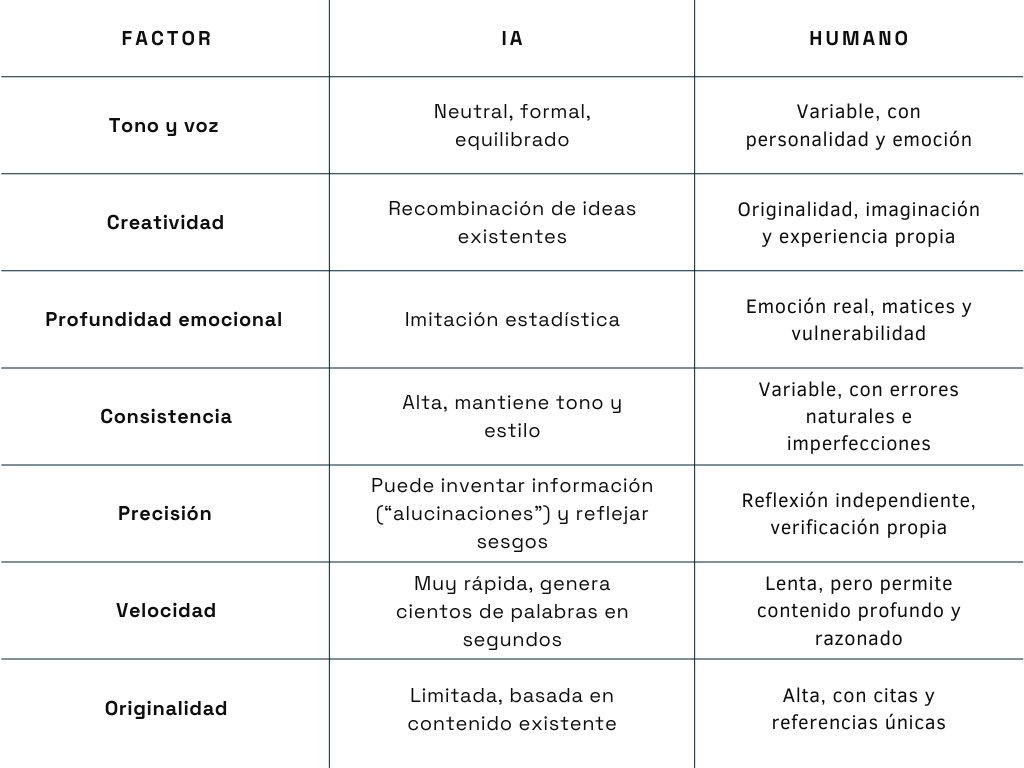
As observed, AI excels in speed and consistency, but humanity brings emotion, authenticity, and creativity. This is why AI-generated texts can sound flawless but often lack life.
The Impact of AI on Language
The expansion of AI-generated prose may have consequences for the evolution of language. Studies by Dr. Tom Juzek and Dr. Zina Ward show that repeated exposure to certain AI terms and structures influences even the way humans speak or write. This raises concerns about a feedback loop, where AI reinforces its own biases and homogenizes language.
How to Detect AI-Generated Writing
Some signs that may suggest a text was generated by AI include:
- Excessive grammatical and spelling perfection.
- Starting paragraphs with standard phrases or clichés.
- Absence of concrete examples or personal experiences.
- Rigid transitions between sections and paragraphs.
- Use of balanced structures and repetitive phrasing.
However, as Mahadevan warns, there is no infallible heuristic: digital media literacy and source verification remain essential.
Combining the Best of Both Worlds
The true victory is not choosing between humans or AI, but integrating them complementarily.
- AI can handle rapid generation, drafts, and summaries.
- Humans provide voice, emotion, and authenticity, reviewing and adapting generated content.
In this way, you achieve content that is efficient, engaging, and truly human, ready to impact the audience.
AI has transformed writing, making it faster and more accessible, but it still cannot replace the richness of human writing: its emotions, nuances, creativity, and unique perspective.
As Dr. Juzek summarizes: “Previously, the quality of form was closely linked to the quality of content. ChatGPT broke that bond”.
Therefore, AI-generated prose and human writing are not enemies, but allies. The key lies in leveraging AI's efficiency and nurturing it with human depth and authenticity, ensuring that every text is not only correct but also memorable and meaningful.